
What we do is costly! Your support will help us dig more stories.
Yes, I'm Interested!Ignorance isn't always bliss | Don't stay foolish.
Keep informed | Read our news and analysis.

About a year ago, the idea that speculative investment has created an “AI bubble” began to take hold and soon became conventional wisdom. Since bubbles always burst, the fear now is that time is running out for this one.
The interplay between AI deployment and financial speculation can be analyzed independently of the debate between doomers and accelerationists over whether generative AI will liquidate humanity or usher in a golden age of abundance. In fact, the boom and the bubble could both be over before that debate is resolved.
In a recent blog post, Noah Smith examined how massive investments in AI infrastructure and training are reshaping the relationship between the real economy and the financial system. As hyperscalers increasingly rely on borrowed money to finance those investments, he observed, they will have to generate ever larger revenues and cash flows to justify them.
That makes this a good time to look beyond the current AI boom and adopt a longer-term perspective on financial bubbles. In my 2018 book Doing Capitalism in the Innovation Economy, I propose a framework for understanding the dynamics that drive bubbles and their potential consequences.
The first “law” of bubbles is that any tradable asset can become the object of speculation. Speculative demand can drive the valuation of any asset to levels decoupled from the cash flows—past, present, or prospective—that represent its fundamental value. This phenomenon can be traced to the dynamics of financial markets populated by investors who do not know and cannot know the future. Recognizing that no one else can know, either, market participants watch what others do and follow suit. Each investor rationally tries to anticipate their peers’ behavior, producing the collective exercise in irrationality we call a bubble.
John Maynard Keynes famously captured this dynamic in his metaphor of the beauty contest:
“Professional investment may be likened to those newspaper competitions in which the competitors have to pick out the six prettiest faces from a hundred photographs, the prize being awarded to the competitor whose choice most nearly corresponds to the average preferences of the competitors as a whole; so that each competitor has to pick, not those faces which he himself finds prettiest, but those which he thinks likeliest to catch the fancy of the other competitors, all of whom are looking at the problem from the same point of view.”
Two-Dimensional Bubbles
Neither regulatory changes nor technological advances have altered this basic dynamic. But while bubbles are ubiquitous, not all of them are the same. I have found it useful to distinguish bubbles along two dimensions, illustrated by the figure below.
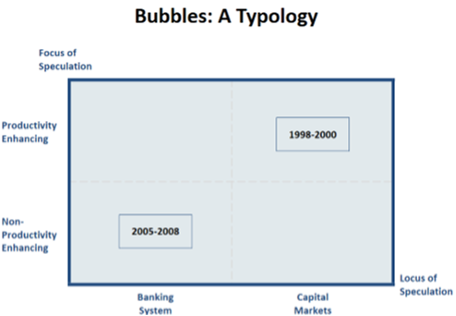
The first dimension is the focus of speculation. Can the assets whose deployment is being financed by speculative investment expand the economy’s productive capacity? This was the case with the 19th-century railway manias, the bull market of the “Roaring Twenties” that financed the buildout of the US electricity grid, and, most recently, the dot-com bubble that funded the internet’s global deployment at the end of the 20th century.
By contrast, the Dutch tulip bubble of the 1630s revolved around tulip bulbs, which were decidedly unproductive. After some 15 years of experimentation and hype, much the same can be said of crypto. Real estate, both commercial and residential, has also repeatedly been the subject of speculative booms. The great credit boom of 2005–08, amplified by modern mathematical finance through seemingly endless varieties of derivative credit structures, is the most recent example of a thoroughly unproductive bubble.
Productive bubbles are just as certain to burst as unproductive ones. Sooner or later, economic fundamentals assert themselves. As the cash flows implicit in asset valuations fail to materialize, more and more investors recognize that the valuations cannot be sustained until a tipping point is reached. The collapse may be triggered by a high-profile failure, like that of Jay Cooke & Co. in New York in 1873. Or it may follow a less dramatic but ultimately decisive conviction that “enough is enough,” as happened in the spring of 2000. Either way, the bubble bursts.
The second dimension of bubbles is the locus of speculation, which becomes especially important when bubbles pop. Was the bubble financed principally through the relatively unleveraged equity and high-yield bond markets? Or did the speculation penetrate the core banking system that finances the working capital of businesses and the real estate that accounts for much of the net worth of workers and consumers?
In a 2015 paper, Òscar Jordà, Moritz Schularick, and Alan M. Taylor examined 140 years of historical financial data, concluding that “what makes bubbles dangerous is the role of credit.” Their findings are consistent with the distinction highlighted by former Federal Reserve Governor Frederic Mishkin and other policymakers in the aftermath of the 2008 financial crisis. Whereas “pure, unleveraged ‘irrational exuberance’ bubbles” may “pose a limited threat to financial stability or the macroeconomic outlook,” rising asset prices and increasing leverage reinforce one another during “credit boom bubbles.”
When credit boom bubbles burst, Mishkin explained, “the resulting deleveraging depresses business and household spending, which weakens economic activity and increases macroeconomic risk in credit markets.” This was very much the story of the 2008 crisis and the Great Recession. Indeed, when the dot-com bubble burst in 2000, WorldCom and Global Crossing—the two leading builders of the fiber-optic networks that carried internet traffic—went bankrupt, and WorldCom’s senior executives were even jailed for fraud. But these investments in infrastructure had been funded by junk bonds, not bank credit. The economic consequences were thus limited and could be managed through conventional monetary policy.
The Search for AI’s Killer Apps
Historically, when productive bubbles burst, the infrastructure they funded remained in place. No one tore up the railroad tracks, dismantled the electricity grids and power stations, or dug up the fiber-optic cables. While the first movers of each era lost vast amounts of their investors’ capital, those who followed eventually developed the killer applications and reaped the rewards.
For the railroads, the killer app was mail-order retail, pioneered by Montgomery Ward and Sears Roebuck in the 1880s and made possible by the development of Railway Express. Electrification took much longer, with 50 years passing between Edison’s launch of the first electricity-generating station in 1882 and the point when the electrification of manufacturing produced the fastest productivity growth in American history. In between came the buildout of regional electricity networks and the invention of the unit-drive motor.
Similarly, the fiber-optic backbone laid down during the telecom boom of the 1990s found its killer app in streaming, but only after broadband access became commonplace and advances in data-compression algorithms made it viable.
This is where the history of earlier general-purpose technologies offers a lesson for today’s AI boom. It is not too early to conclude that generative AI will deliver meaningful productivity gains across a wide range of applications. In other words, we can expect the current frenzy to be remembered as a productive bubble. But will those gains arrive soon enough, and will they be big enough, to justify the enormous investments already being made in AI infrastructure, let alone the hundreds of billions in commitments that have been announced?
We are now in a period of trial-and-error experimentation, of the kind Geoffrey A. Moore described during the IT revolution a generation ago. Identifying worthwhile applications, let alone world-beating ones, takes time, and complementary inventions are needed to adapt general-purpose technologies to particular uses. Another potential cause of delay is the need to insure against the risks of using AI across numerous domains, from medicine to autonomous vehicles. In fact, another factor slowing the buildout is the need to insure data centers and supporting power stations.
Slowing the Race for Returns
Because timing is everything for productive and unproductive bubbles alike, keeping track of leverage is critical for AI investment. Encouragingly, many observers are doing just that, and there are signs that financial markets are beginning to pay attention. CoreWeave’s recent selloff is a case in point.
As investment has surged, AI financing has become increasingly complex and leveraged. So-called “circular financing,” exemplified by Nvidia funding both the hyperscalers and their customers, the developers of large language models, provides ample grounds for concern, so much so that it now has its own Wikipedia entry. The growing reliance on private credit to fund today’s buildout, with lenders themselves borrowing from banks, is bringing the AI bubble closer to the core of the financial system.
The AI bubble may still deflate rather than burst. In that case, evidence of slowing growth among LLM providers, especially Anthropic and OpenAI, along with delays and cancellations in data-center construction, may paradoxically be good news for the system as a whole. The radical shift in public attitudes toward data centers is also dampening the irrational exuberance that greeted ChatGPT’s launch four years ago.
Nevertheless, the risk of a sudden, destabilizing collapse remains. The Trump administration’s track record so far inspires little confidence in its ability to handle an AI bust. Investors would do well to remember the words of Bernard Baruch, the iconic mid-20th-century speculator and presidential adviser. When asked how he made his fortune, he replied, “By selling too soon.”
Read More Stories

NEPSE gains nearly 60 points this week as turnover surges 51%
The stock market witnessed a slight correction on Friday, ending its three-day winning...

The limits of justice in the shadow of Garima’s death
The streets of Simara echoed with grief and fury when a young life,...

Lumbini Development Trust: The institution managing Buddha’s birthplace, billions in funds
Lumbini is more than a religious destination. Recognised as the birthplace of Siddharth...