
What we do is costly! Your support will help us dig more stories.
Yes, I'm Interested!Ignorance isn't always bliss | Don't stay foolish.
Keep informed | Read our news and analysis.
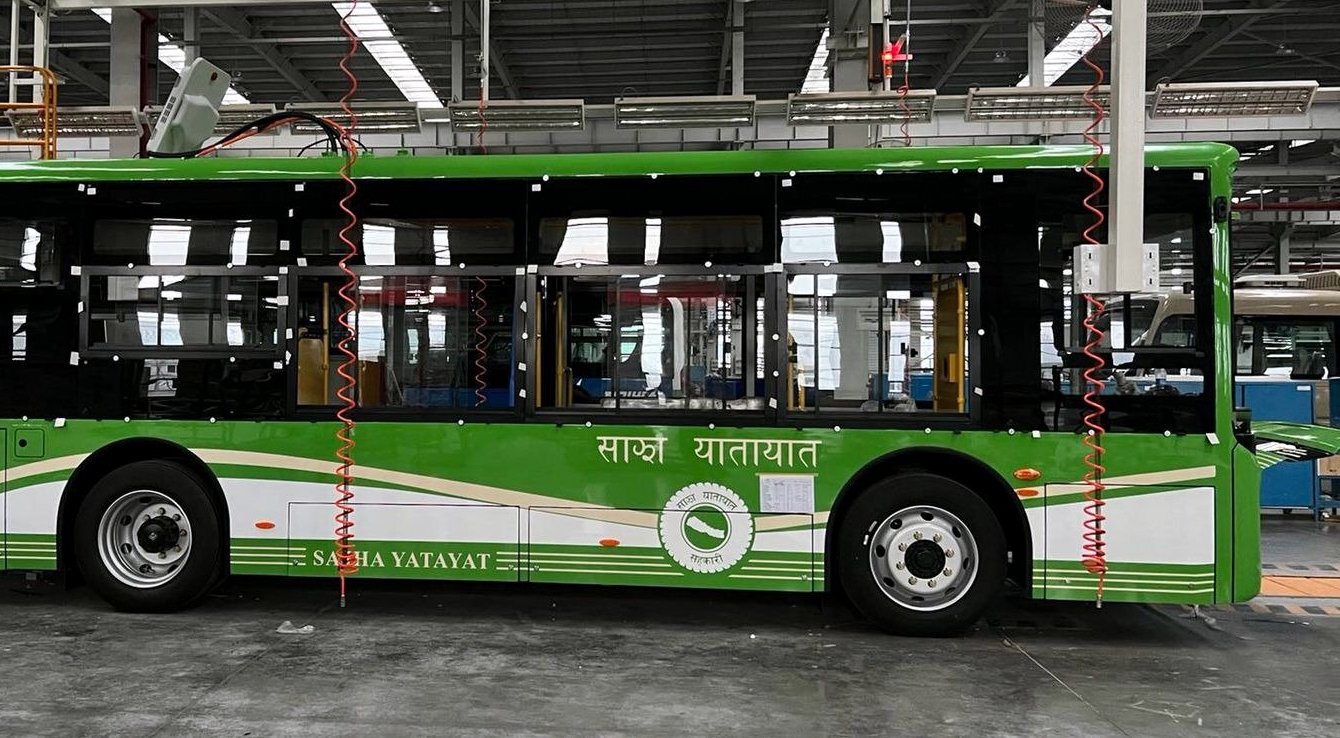
37 electric buses that Sajha Yatayat — a cooperative-based public transportation service provider — had purchased are yet to begin operation.
Only three electric buses that were piloted in July 2022 are operational in the valley at the moment. The rest of the 37 e-buses that left for Nepal via Tatopani checkpoint in Sep 2022 are now languishing across parking spaces in Banepa, Pulchowk, and Pokhara, reports onlinekhabar.com.
Reportedly, Sajha Yatayat is yet to decide on the routes and figure out charging stations and parking spaces for the new e-buses and is accused of inadequate research and planning.
A 161-kW battery-powered electric bus takes four hours to charge completely and has the capacity of travelling 200 km when fully charged. The 26-seater buses, with a total capacity of over 42 passengers and a space for a wheelchair, are equipped with wifi networks, TV displays, and CCTV.
Sajha had struck the purchase deal with a Chinese firm, CHTC KINWIN (NANJING) AUTOMOBILE Co., Ltd. back in October 2021.
The agreement included the purchase of 40 e-buses and 20 chargers at a total cost of $3.7 million (taxes excluded) and Rs 67.4 million (training and maintenance for five years, including spare parts).
Earlier, Sajha failed to operate five electric buses it had borrowed from Lumbini Development Trust that was actually intended for Gautam Buddha International Airport. The incumbent Prime Minister KP Sharma Oli amid special fanfare had inaugurated the Sajha’s initiative.
In July 2019, the Bagmati Province government and Lalitpur Metropolitan handed over NRs 325 million to Sajha while Kathmandu Metropolitan announced to chip in NRs 100 million to run valley buses but the agreement failed due to issues concerning shareholding.
Based on 2078/79 audit reports of the Sajha Yatayat, the company has investments of Rs 3.03 billion from the Ministry of Physical Infrastructure and Transport while local bodies such as Kathmandu Metropolitan and Lalitpur Metropolitan each have investments of Rs 150 million and Rs 35 million respectively out of a paid-up capital of Rs 3.45 billion.
Read More Stories

NEPSE rises 28 points as trading activity improves
The stock market rebounded on Friday, with the NEPSE index gaining 27.94 points,...

Government estimates NRs 723 billion needed to rebuild flood-damaged areas
The government has estimated that NRs 723.31 billion will be required to rebuild...

Market falls by double digit for second session as turnover declines
The stock market extended its decline for a second consecutive session on Thursday,...