
What we do is costly! Your support will help us dig more stories.
Yes, I'm Interested!Ignorance isn't always bliss | Don't stay foolish.
Keep informed | Read our news and analysis.
diplomacy | international relations | bilateral ties | treaty
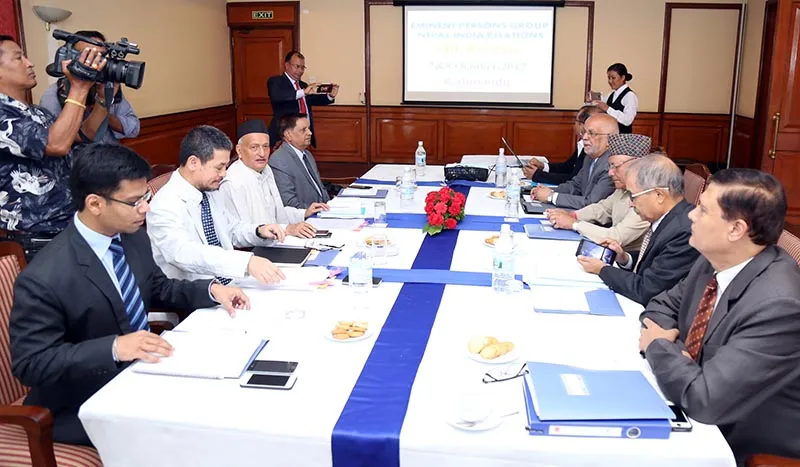
In 2016, Nepal and India decided to form an Eminent Person Group (EPG) — a panel of notable individuals as representatives from the two nations mandated with the responsibility of redefining Nepal-India bilateral ties by reviewing and revising the past agreements and treaties between the two nations, including the Friendship Treaty of 1950, in line with the changing realities of the two countries.
The decision to form the group came after the relations between the two countries hit rock bottom after the 2015-16 Indian blockade on Nepal although it was first proposed in 2011 by the then PM Baburam Bhattarai.
In 2017, Indian PM Narendra Modi and Nepal PM K.P. Oli nominated eight members (four each from the two nations) for the panel and agreed that the recommendations wouldn’t be binding.
On Nepal’s side, the EPG members comprised Bhekh Bahadur Thapa (group coordinator at Nepal panel and former minister at the Ministry of Foreign Affairs and Ministry of Finance), Nilamber Acharya (former Nepal ambassador to India), Rajan Bhattarai (former foreign affairs adviser to PM Oli), and Surya Nath Upadhyay (former CIAA chief commissioner).
Bhagat Singh Koshyari (group coordinator at India panel and former chief minister of Uttarakhand), Jayant Prasad (former Indian ambassador to Nepal), Mahendra P Lama (Development economist and a university professor), and BC Upreti (a scholar on South Asian studies, now deceased) were appointed as representatives from the Indian side.
It was later agreed, during the final rounds of group discussions, that the Indian PM would first receive the report, and then the Nepali counterpart.
In July 2018, the group finalised a consensus document after a round of meetings and discussions outlining the future course of Nepal-India relations.
Reportedly, the report had recommended replacing the 1950 treaty with an updated version, regulating the border with a provision for producing identity cards for travellers, and jointly tackling the problems of terrorism, extremism, and trafficking. The recommendations also concern the areas of commerce and trade, water resources, and people and cultural ties.
However, owing to ‘his busy schedule’ PM Modi’s office is yet to receive the report that was mandated in mutual agreement — the report gathering dust for almost five years now.
Nepal has frequently sought to revise its treaties with India, particularly the 1950 Treaty of Peace and Friendship, which it considers unequal — for instance, its article 7 where the two countries agree to grant, on a reciprocal basis, to the nationals of one country in the territories of the other the same privileges in the matter of residence, ownership of property, participation in trade and commerce, movement and other privileges of a similar nature — due to the vast difference between the two country’s economic, geographic and demographic size.
The treaty was signed by PM Mohan Shumsher Jung Bahadur Rana on behalf of Nepal some 73 years ago during the last years of the autocratic Rana regime in Nepal.
Read More Stories

NEPSE rises 28 points as trading activity improves
The stock market rebounded on Friday, with the NEPSE index gaining 27.94 points,...

Government estimates NRs 723 billion needed to rebuild flood-damaged areas
The government has estimated that NRs 723.31 billion will be required to rebuild...

Market falls by double digit for second session as turnover declines
The stock market extended its decline for a second consecutive session on Thursday,...